You want Houston tree experts who know humid heat, Gulf storms, and clay-heavy soils. Look for ISA Certified Arborists using ANSI A300/Z133 standards, with OSHA/EHAP safety training and verified insurance (liability coverage $1–2M, workers' comp, aerial ops). They should schedule pruning to minimize storm breakage and disease (oak wilt windows), evaluate hazards, and improve root zones with air-spade, mulch, and evapotranspiration-tuned irrigation. Require documented risk assessments, clear scopes, and like-for-like quotes. Read on for specific steps to decide confidently.
Core Insights
Why Local Proficiency Is Essential in the Houston Climate
Since Houston's climate swings from humid heat to sudden Gulf storms, local tree care expertise directly impacts safety, plant health, and cost. You need pros who understand clay-heavy soils, high evapotranspiration, and wind-load patterns from tropical systems. They'll recommend native species adapted to drought-and-flood cycles, minimizing transplant failure and irrigation demand. Certified arborists evaluate canopy sail area and root plate stability, then time seasonal pruning to minimize pathogen entry and storm breakage. They know pecan scab, oak wilt risk windows, and when to avoid pruning live oaks to prevent vectored infection. Local expertise calibrates fertilization to soil test data, selects storm-resilient structure, and sets clearance standards for utilities. The result: fewer failures, lower lifecycle costs, and significantly safer properties year-round.
Professional Care That Keeps Your Trees Healthy and Secure
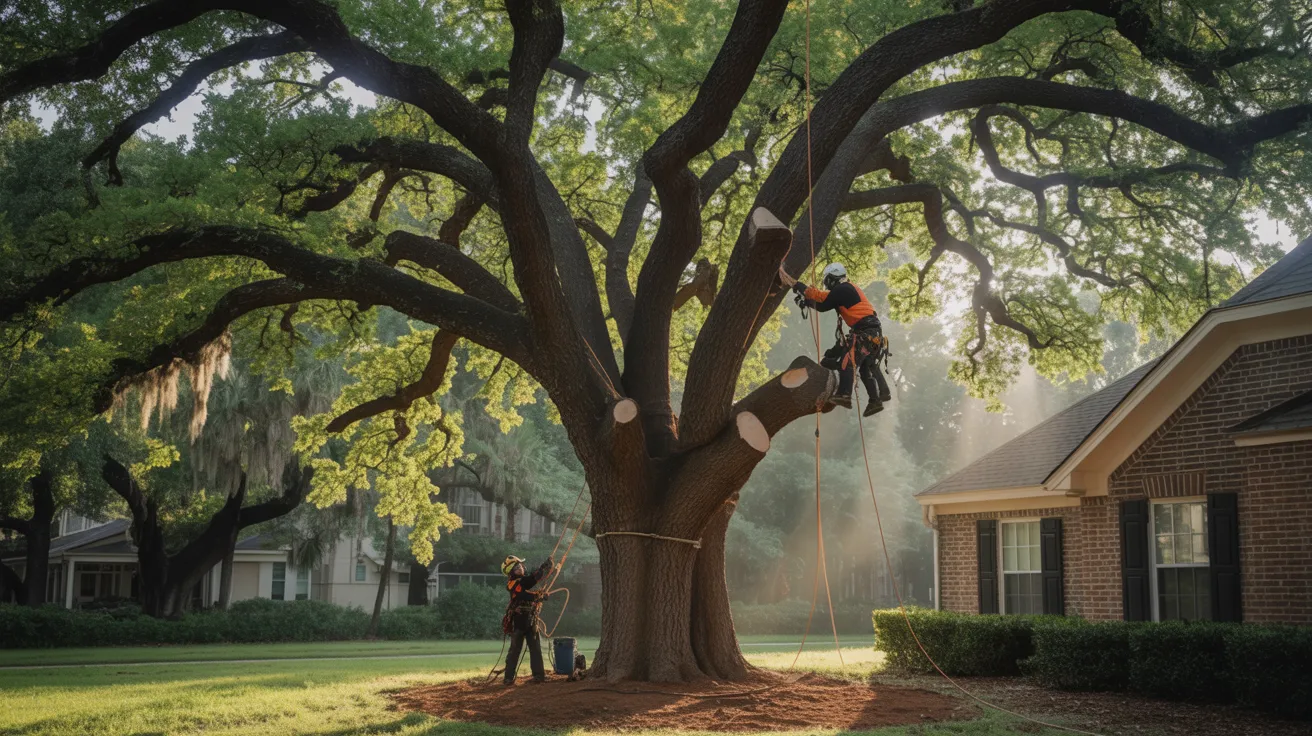
Ranging from preventive pruning through emergency storm response, the right services ensure your trees remain stable, healthy, and code-compliant. You'll gain from seasonal pruning that addresses weak, crossing, or storm-damaged limbs to decrease wind sail, strengthen structure, and protect nearby utilities. Hazard assessments reveal defects like codominant stems, included bark, and decay pockets, informing precise mitigation like cabling, bracing, or staged removals.
To safeguard root health, professionals use air-spading to address girdling roots, alleviate soil compaction, and expose flare depth. They'll improve soil with mulch calibration, organic matter, and biochar where applicable, then fine-tune irrigation to evapotranspiration rates. Nutrient management relies on soil and foliar testing before prescriptions. Lightning protection, clearance pruning from structures and lines, and post-storm triage further decrease risk while protecting canopy health.
Credentials, Insurance Coverage, and Safety Standards to Verify
You've observed how proactive care decreases check here risk; now confirm the people doing the work meet verifiable standards. Start with license verification: confirm an active Texas contractor registration and any applicable municipal permits. Ask for ISA Certified Arborist credentials and verify them online. Examine safety certifications such as OSHA 10/30 training, EHAP training, and CPR/first aid training.
Demand written proof of general liability (minimum $1–2 million aggregate) and workers' compensation; obtain certificates sent directly from the insurer. Verify coverage includes aerial operations and tree rigging. Evaluate documented safety programs: job hazard analyses, lockout/tagout for equipment, chainsaw PPE compliance (head protection, protective eyewear and ear protection, chainsaw pants), and ANSI Z133 adherence. Mandate calibrated equipment, pre-job safety briefings, and incident reporting. Avoid proceeding without verifiable references and clean safety records.
What You Can Expect During an On-Site Assessment
During an on-site inspection, the arborist conducts a structured walkthrough to examine tree health, structural integrity, and site-specific hazards. You can expect visual and tactile examinations of the canopy, trunk, and root flare, with attention to decay fungi, cracks, codominant stems, and included bark. The arborist will evaluate soil compaction, drainage, and root-zone disturbance, and note proximity to utilities, buildings, and traffic.
The certified arborist identifies target areas and potential for failure using industry assessment matrices. The professional considers accessibility considerations for equipment placement, load paths, and protection of hardscape elements and lawn areas. Seasonal timing is significant: in Houston, dormant-season pruning may reduce stress and disease pressure, while post-storm evaluations concentrate on windthrow and hangers. You'll hear recommendations for mitigation like pruning, cabling/bracing, or removals, plus debris handling and site protection plans.
Comparing Quotes and Choosing the Right Crew
Armed with the assessment outcomes, you can obtain like-for-like quotes that specify scope, methods, and standards. Request line items for labor hours, equipment type (bucket truck versus climbers), debris handling, traffic control, and stump grinding. Confirm insurance limits and ANSI A300 compliance. Require price transparency, including mobilization fees and contingencies for decay or utility conflicts.
Examine scheduling, supervision ratios, and certification levels (ISA Certified Arborist, TRAQ). Verify crew reputation through recent, local references and documented safety recordables (TRIR) or incident-free hours. Prioritize firms with written job hazard analyses and utility locator coordination. Assess communication: pre-job briefings, change-order protocol, and photographic before/after documentation. Avoid going with the lowest bid if it omits rigging plans, protection for structures/landscapes, or post-service cleanup standards—risk costs more.
Questions Asked Frequently
How Might Seasonal Allergies Influence Scheduling Tree Work Near My Home?
Seasonal allergies affect scheduling by aligning work with low pollen timing to reduce exposure. You should plan pruning before peak bloom or after heavy rains when airborne counts drop. Use allergen mitigation: wet cutting, HEPA vacuums, and sealed PPE (N95/P100, goggles). Schedule early morning or after cold fronts. Keep windows closed, run MERV-13 filtration, and shower after work. Verify species-specific pollen calendars and monitor local counts to adjust dates safely and effectively.
Will Tree Services Help With HOA Approvals or City Permits?
That's correct. Nearly all professional tree services help with HOA approvals and city permits. They provide site assessments, species and diameter documentation, and stamped plans if needed. They manage permit navigation, submit tree protection and traffic-control plans, check utility locates, and schedule inspections. They deliver ISA-certified arborist reports, risk evaluations, and mitigation measures to meet ordinances. You stay compliant, avoid fines, and maintain safe operations, from pruning and removals to stump grinding and debris hauling.
What Are Typical Emergency Response Times After Storms?
In storm situations, you'll typically see rapid arrival within 2 to 4 hours for life-safety hazards; non-emergency scenarios get attention the same or next day. To cut to the chase, teams use systematic prioritization: removing impassable streets, compromised electrical lines, and trees on buildings first. You'll be provided with a site safety assessment, emergency stabilization, and debris removal. Count on credentialed arborists, specialized equipment around power lines, and formal risk assessments. Response intensity varies with electrical failure scope, route availability, and active utility coordination.
Are There Eco-Friendly Options for Debris Disposal or Mulching?
Certainly. You can pick eco-friendly debris disposal or mulching solutions. We process branches on-site into mulch, confirm moisture content, and size particles to enhance erosion control and soil health. Logs transform into renewable biomass or are milled when structurally sound. Fines and leaves proceed to organic composting with temperature tracking for pathogen reduction. We avoid contaminated species, segregate invasives, and adhere to ANSI A300 safety protocols, PPE, and equipment guards to safeguard you, your property, and workers.
How Can I Limit Inconvenience to Neighbors During Tree Services?
Begin by planning work mid-morning to prevent quiet hours, then implement noise reduction: sharp chains, electric saws, and mufflers. Inform neighbors 48 hours ahead with timelines. Designate drop zones, use ground mats for driveway protection, and stage equipment off-street. Limit chipper use to short bursts; stack brush quietly first. Control dust with misting, and assign spotters to manage traffic. Comply with ANSI Z133 protocols, install barricades, and conclude with a comprehensive sweep and magnet pass.
Closing Remarks
In Houston's storm-swept canopy, you act as custodian, not chance-taker. When you hire credentialed arborists, you're opting for measured methods over assumptions—insured crews, ISA certification standards, ANSI Z133 safety, recorded weight thresholds. The correct crew examines soil similar to accounting books, canopy architecture as engineering plans, and hazard as meteorological data. Throughout evaluations, they test, measure, and justify. Review documented proposals, equipment inventories, and risk strategies—instead of marketing claims. Pick the crew that validates expertise with proof, so your canopy endures.
Comments on “Comprehensive Tree Services Houston”